Friday, March 6, 2015

A Person Must Never Be Allowed to Starve to Death

Theresa Marie Schiavo (1963-2005)
Thank you for the editorial "Every human life deserves dignity" (May 29, 2005), which comes significantly just about two months after Terri Schiavo's death. Since then, the issue of artificially supplied nutrition and hydration has virtually disappeared from the headlines, and it might seem that all the fuss about tube feeding has simply faded away. 

Nevertheless, the question of whether Schiavo was allowed to die or was killed is very much current for those who care for others in similar circumstances. While it is true that the courts allowed Terri's husband to remove his wife's feeding tube – thereby ensuring her death by starvation – they in no way legitimized what he did. Indeed, the drama surrounding Schiavo's demise only serves to illustrate how inhuman this practice is, and the revulsion most people of good will experienced during the ordeal makes it plain that it should never be allowed to happen again.

Unfortunately, as anyone who works in healthcare can attest, it is a situation that recurs with alarming frequency in our hospitals and nursing homes today – often with the prior consent of the victim. Many so-called "living wills" include clauses that allow signers to explicitly reject the artificial administration of food and water if they become incapacitated and unable to eat on their own. By signing these forms, people agree to accept a horrible death, whether wittingly or unwittingly, and too many doctors are all too willing to carry out those wishes once the circumstances present themselves. 

This is the kind of dangerous moral surrender that Pope John Paul II addressed in a speech he made back in March 2004. Speaking to a gathering of experts on persistent vegetative state (PVS), the pope made it very clear that the provision of nutrition and hydration must always be considered a part of ordinary care. Even when artificially administered, John Paul said, food and water "always represents a natural means of preserving life, not a medical act." The debate on this issue among moralists and theologians had gone on for many years, but the Holy Father's clear statement effectively put an end to the controversy. 

Even so, confusion on this issue is rampant, even among Catholics, and even those who were on the right side of the Schiavo issue are unaware of the full implications of her case. Much was made in the media of the question regarding Terri's wishes concerning what she'd want if she were in a PVS, but according to the Holy Father's instruction, a person's wishes are irrelevant to the provision of food and water. Simply put, a person must never be allowed to starve to death, no matter what that person desires or requests. 

A protestor outside the Florida courthouse where Terri's fate was decided.
Obviously, when the provision of nutrition and hydration is no longer serving any purpose at all – when nutrients can no longer be assimilated by the body or are not providing any comfort to someone whose death is imminent – then it may be discontinued. But such a situation was not being addressed by the pope in the spring of 2004; he was addressing a narrowly prescribed set of circumstances, and it seems providential that, almost exactly a year later, the specific circumstances he had referred to burst into the public eye with the battle over Terri Schiavo. We must never forget that Terri was not dying until her feeding tube was removed. This is the crucial point: When food and water are withheld such that a person dies as a direct result, the only possible conclusion is a willful homicide. 

Of course, consideration must be made for the particular circumstances of individual cases, but what the Holy Father has done is to help us know the limits of what can be debated, even in the hard cases. No one is claiming that food and water must be provided at all costs until the very last breath has passed ones lips; what the pope did declare is that no one should ever die from starvation and dehydration – and that is precisely what happens when feeding tubes are discontinued despite the absence of underlying pathologies that naturally lead to death. In fact, John Paul refers to such precipitate withdrawals of food and water as "euthanasia by omission."

No one would choose to be in a PVS for any length of time – whether 15 years or five years or even the required one year to attach that label to someone – but unforeseen and unfortunate things happen all the time, and it is in those very unforeseen and unfortunate situations that we are closest to the cross. Our brothers and sisters who are in a PVS (or "post-coma syndrome," as some Catholics writing on this topic are calling it to get away from the negative connotations associated with "vegetative") require our love an care. They are Christ, the Christ of Matthew 25 – "when I was hungry, you fed me; when I was thirsty, you gave me drink."

Can we do otherwise?
______________________________


A version of this essay originally appeared in Today's Catholic on June 19, 2005. Terri Schiavo died of marked dehydration on March 31, 2005.

Friday, February 27, 2015

Hydration at the End of Life: Avoiding Unnecessary Dehydration

"The deliberate withholding of food and water, regardless of how it is administered, can constitute a form of passive euthanasia, particularly when the intention is to hasten the patient's death. 

"The Church has made it abundantly clear that all forms of euthanasia, whether passive or active, are gravely immoral and must be avoided."


Thursday, January 22, 2015

Real Life

Originally posted on Facebook, July 12, 2013. 

Snowboarding is a world utterly foreign to me, but I'm intimately acquainted with Down syndrome.

My son, Nick, has Down's, and his very life is a window on a world of freedom and joy that I'll never know—except through him. Thank God he's here.

I was reminded of that when I read Dorothy Rabinowitz' WSJ review of The Crash Reel, a documentary about snowboarder Kevin Pearce, his brain injury, and his recovery.

Kevin's story sounds compelling in itself, but what especially struck me was the portrait presented of Kevin's family—especially his brother, David:
David is a riveting presence. He's the family's Down syndrome child, now a young man—urgent, full of passion for his adored athlete brother, the raw voice of anguish over Kevin's accident that the other members of the family try to contain in themselves.
This is what we parents of Down's kids know; it's what the world that aborts them at a rate of 9 out of 10 needs to hear.

Is Down's a piece of cake? No. Here's more from the Pearces:
Mia, Kevin's mother, recalls her initial fear—soon dispatched—that she might not be able to deal with a Down syndrome child. David, that child now nearly a man, reveals details of the unhappiness he feels when he thinks about his condition, a description impressive in its eloquence.
Unhappiness about his condition, but better off dead? Hardly. Life is hard and filled with challenges, but killing to eliminate challenges not only doesn't work—it's terribly, painfully counterproductive. Sometimes, more often than not, the very challenges we wish to avoid turn out to be priceless opportunities that lead to new life. We just can't see it yet.

And when it comes to Down syndrome in particular? I pray for a world that, like Mia Pearce, will dispatch fear instead of persons.

Sunday, January 18, 2015

On the Authoritativeness of Scripture

The Paralytic of Capharnaum is Lowered from the Roof (Byzantine School)
'Problems such as John’s paraphrasing of Jesus’ discourses and the "thatched roof versus tile roof" controversy (cf. Mark 2:4 and Luke 5:19) are not truly divisive, nor are they dangerous to our faith. We agree that the gospels provide us with a generally reliable idea of who Christ was, what he did, and what he said.'

Wednesday, December 10, 2014

St. Benedict Joseph Labre (1748-1783)

A beggar. A bum. A stinking, dirty tramp. A saint. Benedict Joseph Labre is a stunning challenge to our sanitized images of sanctity and, while not a Franciscan, his total embrace of poverty makes him a true kinsman of St. Francis.

The son of a village shopkeeper, Benedict Joseph grew up amid comfortable surroundings in the French countryside. His parents interpreted his reserved manner, evident piety, and concern for the poor as signs of a priestly vocation and sent him away for an education.

Benedict Joseph Labre, depicted by Antonio Cavalluci (1795)
Benedict studied under his uncle, a parish priest, but the boy's heart was rarely fixed on his Latin lessons. Instead, he gravitated to the transient poor of the byways and lonely places, and he delighted to mingle with them, often emptying out his pockets among them. Labre's attraction to the despised appeared eccentric to his contemporaries, no less than to us, yet his impulse was right – he intuitively recognized the continuity between his time with outcasts and the long hours he spent before the Eucharist.

During a cholera outbreak, the priest and student selflessly cared for the sick and dying. After losing his uncle to the disease, Benedict left his studies and career behind, determined to follow his true calling – poverty, hiddenness, and prayer. He set out with his family's permission to locate a monastic family where he could lose himself in abandonment to God.

The Carthusians, the Cistercians, the Trappists – all turned him away due to his curious affinities and poor health. But he never gave into discouragement. He knew God was faithful and would lead him aright, and as it turned out, Labre's wanderings proved to be a providential trajectory that did indeed set him on his life's course.

For Benedict Joseph's calling was to be a monk with a singular vocation: His monastery became the world, his chapel the streets, and his habit rags and filth. Like St. Francis, Labre's heavenward gaze was so intense, so fixed, that he found it difficult to conform to any of the world's categories – even the best of them – and he found his niche by not having a niche.

Giving up on monastic life, Labre made a pilgrimage to Rome in 1770. In the next six years, the saint crisscrossed the European landscape: Always on foot, generally sleeping outside, rarely begging, and accepting only those alms he needed for any given day. With an old cloak, his Rosary beads, and a couple of books as his only possessions, he made multiple journeys to a variety of shrines, including Loreto, Compostela, and, fittingly, Assisi. His days were spent in prayer and his nights among the homeless poor. Since he never cared for his body, he was often reviled and abused – signs to him of God's special favor.

Eventually Benedict settled in Rome, and he served the rest of his life as the Eternal City's holy fool, destitute yet joyful. He frequented many of the city's churches, and had a particular enthusiasm for the then-popular Forty Hours devotion. The supplicant would sit for long stretches in silent meditation before the tabernacle, completely enveloped in the presence of Christ, and then retire to the ruins of the Colosseum, his adopted home, to spend a good part of his night in further, intense prayer. 

Labre's tomb in S. Maria dei Monti, Rome. The effigy was made by Achille Albacini in 1892.
In his last days, Labre's rapidly declining health forced him to find refuge in a poor house. On Wednesday of Holy Week, 1783, the 35-year-old beggar collapsed on the steps of a church; he later died peacefully in the home of a friendly butcher. Immediately the city's children took to the streets exclaiming, "The saint is dead! The saint is dead!" The entire populace turned out to pay their respects and extra police had to be brought in to control the crowds. As Donald Attwater says in his Dictionary of Saints, "The people of Rome never had any doubt about the holiness of this 'new St. Francis,' and he was eventually canonized."

Benedict Joseph is truly a saint for our times. His radical detachment – from possessions, from the world, even from himself – shows up the emptiness of modern self-absorption and greed. Not that we should all resort to a semi-contemplative existence on the streets, but we would do well to follow Labre's lead in cultivating detachment and put away whatever distracts us from God.

Therein lies sanctity and sanctity is our destiny – we only must seize it, and God gives us the grace to do so. God can fashion a saint from a homeless tramp; he can make saints of us. All he needs are the raw materials.

A version of this essay was originally published in Franciscan Way, Franciscan University of Steubenville.

Thursday, November 27, 2014

St. Crispin of Viterbo (1668-1750)

St. Crispin of Viterbo, OFM Cap.
"I've got shoes, you got shoes, all God's children got shoes." The old spiritual conjures up numerous biblical images of feet, shoes, and hoofing it for the Lord. St. Paul tells the Ephesians to "stand fast, your feet shod in readiness for the gospel of peace" (6:15), and to the Romans he quotes the prophet Isaiah when he declares, "How beautiful are the feet of those who bring the good news" (10:15; Isa. 52:7).

St. Crispin of Viterbo was one well acquainted with footwear as well as the link between faith and feet, for though he worked as a shoemaker in his youth, he was destined to spend his latter days unshod as a Franciscan beggar for God.

Brother Crispin was born Pietro Fioretti to a poor family in Viterbo, a small town north of Rome. His mother dedicated Pietro to the Blessed Virgin at a local shrine, instructing her son that Mary was also his mother. Accordingly, Pietro grew up with a deep devotion to the Queen of Heaven and referred to her affectionately as his "other momma."

Pietro was vigorous in his pursuit of sanctity, but physically frail, so he was fortunate in obtaining a cobbler's apprenticeship from his uncle. This benevolent uncle also saw to his nephew's schooling and enabled the boy to acquire a rudimentary training in Latin from the Jesuits. Nevertheless, Pietro was unable to pursue a learned profession, and instead excelled as a shoemaker while all the time seeking perfection in the science of the saints. 

When Pietro was 25, he observed a group of Capuchin novices process through the streets of Viterbo, and the Lord gave him a clear interior message that he was called to religious life. Immediately presenting himself to the superior of the local Capuchin friary, Pietro requested admittance to the order, but was turned away due to his sickly appearance. The cobbler, convinced of God's call, was not dissuaded, and he doggedly made his case. Eventually, the superior relented and admitted Pietro to the Franciscan family.

The new novice took the name Crispin to honor the patron saint of his trade, although he forever put aside his shoemaking skills. At first he cooked for his community; then he took up work in the gardens and orchards. Crispin also worked in the infirmary, where he acquired a widespread reputation for healing, both physical and spiritual. Once he effected a cure for a Vatican chamberlain, and the pope's own doctor praised the Capuchin brother's art. Crispin demurred and humbly attributed his success to Mary's intercession, saying that "the Blessed Virgin can do more than all the physicians in the world."

Brother Crispin eventually settled in Orvieto where he was appointed questor, or "beggar of alms" – a role he fulfilled for over 40 years. Crispin was seen constantly in the streets, joyfully exhorting the rich to give of their abundance, and equally joyful in providing for the needs of the poor and his brother friars. Beloved by all, respected for his peacemaking abilities, and revered for the care he provided the sick, orphaned, and imprisoned, Crispin was considered by many in the town a close personal friend. Indeed, when the superior assigned another brother to be questor, the homemakers of Orvieto denied the newcomer entry, and flatly refused to support the community until Brother Crispin was restored to his post. 

Calling himself the "beast of burden of the Capuchins," Crispin cheerfully took on all tasks, no matter how difficult or unpleasant. When epidemics broke out among his brother friars in distant convents, he went to care for them, heedless of the risk to his own health. Also, he personally attended to the foundlings left on his community's doorstep, and not only provided for their immediate physical needs, but also arranged for their future training in a trade.

Brother Crispin's years of selfless service finally took their toll during the winter of 1747-48 when he contracted pneumonia. After two years of suffering from his infirmities, Crispin anticipated his death in the joyful spirit of the psalmist:
I rejoiced because they said to me, "We will go up to the House of the LORD." And now we have set foot within your gates, O Jerusalem (Ps. 122:1-2).
Pope Pius VII beatified Brother Crispin in 1806, and Pope John Paul II, in the first canonization of his pontificate, declared the Capuchin cobbler a saint in 1982. His feast is celebrated by Franciscans on May 21.

A version of this essay was originally published in Franciscan Way, Franciscan University of Steubenville

Saturday, October 25, 2014

A Son Named Crispin

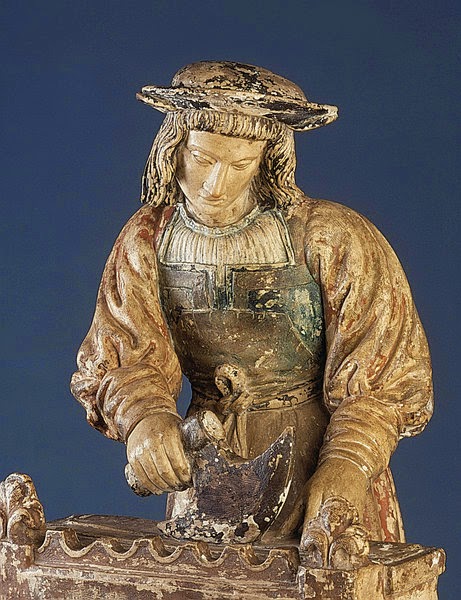
Limestone sculpture of St. Crispin (1400-1600, France)
We named our second son Crispin. It’s not an uncommon name in the U.K., but it’s pretty darned rare ‘round these parts.

I wish we could say that our choice was inspired by the saint, but it wasn’t. The fact is, we were watching the BBC's "Pride & Prejudice" just weeks prior to Cris’s birth, and there it was in the ending credits: Crispin Bonham-Carter, the actor who played the excellent Mr. Bingley in that sublime production.

“Crispin, Crispin,” I murmured to Nancy. “That’s a strong boy’s name, don’t you think? And I know there’s a St. Crispin.”

Yes, St. Crispin, as in St. Crispin’s day – the one forever enshrined in Shakespeare’s Henry V.

And today is that day. It’s not on the universal calendar as far as the Church is concerned, but it’s definitely on the universal calendar of those with any kind of literary bent. The St. Crispin’s day speech in Shakespeare’s play has got to be one of the most stirring orations of all time – even those of us with little familiarity with Shakespeare get it.
And gentlemen in England now a-bed
Shall think themselves accursed they were not here,
And hold their manhoods cheap whiles any speaks
That fought with us upon Saint Crispin's day.
It makes you want to get up and do something heroic, something noble and courageo
us, doesn’t it? And it’s exactly the kind of spirit any father would want to instill in his children – something King Henry anticipates a bit earlier in the speech.
This story shall the good man teach his son;
And Crispin Crispian shall ne'er go by,
From this day to the ending of the world,
But we in it shall be remember'd.
Kenneth Branagh as 'Henry V' (1989)
As my own Crispin got older, I did my best to fulfill that prediction, and the speech became a regular fixture in our home each October. For years, on this day, we’d get out the Henry V soundtrack CD (the one from the brilliant film version directed by and starring Kenneth Branagh), and then put on the music from the St. Crispin’s Day scene. I’d dust off our big collected works of Shakespeare, and locate Henry V, act IV, scene 3. As best I could, I’d attempt to synch my recitation of the speech with the music, but it never mattered much in the end, because I don’t think I’ve ever gotten through one of Crispin’s feast day recitations without breaking down into a blubbering heap.

Why? What is so moving about this speech, this scene? It’s the sheer audacity of it, I think. No success was guaranteed – in fact, things looked pretty desperate for the English in that fight. They were hopelessly outnumbered and outgunned, and yet the King (in Shakespeare’s version of events) rallied his troops to fight on despite the odds – for their own glory and the glory of the realm. The battle was the thing; success or failure was not in question. Loyalty and dedication to high ideals – and to the crown, to the king – were the prize, and the outcome of the fight itself was up to God.

Bossche, Crispin and Crispinian (1494)
Still, it’s a fictional speech about a fierce battle – a far cry from the saint himself – the patron of cobblers, both him and his brother, Crispinian. They were third century Romans and Christian converts. Their enthusiasm for the Gospel led them to abandon their Romans roots and travel to the Soissons region of Gaul (modern day France) to preach and evangelize and teach everyone about the Lord.

The brothers witnessed by word in the daytime, and by night through their deeds, especially by supporting themselves (and others) through their shoemaking trade. This all took place prior to the legalization of Christianity, and the brothers’ bold testimony ensured that the authorities would catch up to them at some point. Eventually the Emperor’s men did track them down, and the missionary brothers suffered humiliation, torture, and death by the sword.

They died, yes, but their lives had been remarkably fruitful. Here's how my old Butler’s Lives of the Saints summarizes the ministry of those cobbler saints:
The infidels listened to their instructions, and were astonished at the example of their lives, especially of their charity, disinterestedness, heavenly piety, and contempt of glory and all earthly things; and the effect was the conversion of many to the Christian faith.
Irrespective of Shakespeare and the soliloquy, we knew we'd found a worthy namesake for our son, and an inspiring role model for any boy. Happy feast day, Crispin. May your patron and his literary legacy ever inspire you to persevere in the contests you undertake, particularly when the odds are stacked against you.

This story was adapted from an essay that originally appeared on Catholic Exchange.