Saturday, October 25, 2014

A Son Named Crispin

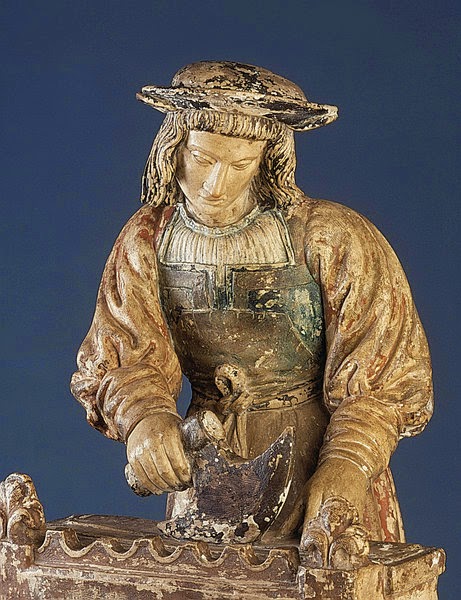
Limestone sculpture of St. Crispin (1400-1600, France)
We named our second son Crispin. It’s not an uncommon name in the U.K., but it’s pretty darned rare ‘round these parts.

I wish we could say that our choice was inspired by the saint, but it wasn’t. The fact is, we were watching the BBC's "Pride & Prejudice" just weeks prior to Cris’s birth, and there it was in the ending credits: Crispin Bonham-Carter, the actor who played the excellent Mr. Bingley in that sublime production.

“Crispin, Crispin,” I murmured to Nancy. “That’s a strong boy’s name, don’t you think? And I know there’s a St. Crispin.”

Yes, St. Crispin, as in St. Crispin’s day – the one forever enshrined in Shakespeare’s Henry V.

And today is that day. It’s not on the universal calendar as far as the Church is concerned, but it’s definitely on the universal calendar of those with any kind of literary bent. The St. Crispin’s day speech in Shakespeare’s play has got to be one of the most stirring orations of all time – even those of us with little familiarity with Shakespeare get it.
And gentlemen in England now a-bed
Shall think themselves accursed they were not here,
And hold their manhoods cheap whiles any speaks
That fought with us upon Saint Crispin's day.
It makes you want to get up and do something heroic, something noble and courageo
us, doesn’t it? And it’s exactly the kind of spirit any father would want to instill in his children – something King Henry anticipates a bit earlier in the speech.
This story shall the good man teach his son;
And Crispin Crispian shall ne'er go by,
From this day to the ending of the world,
But we in it shall be remember'd.
Kenneth Branagh as 'Henry V' (1989)
As my own Crispin got older, I did my best to fulfill that prediction, and the speech became a regular fixture in our home each October. For years, on this day, we’d get out the Henry V soundtrack CD (the one from the brilliant film version directed by and starring Kenneth Branagh), and then put on the music from the St. Crispin’s Day scene. I’d dust off our big collected works of Shakespeare, and locate Henry V, act IV, scene 3. As best I could, I’d attempt to synch my recitation of the speech with the music, but it never mattered much in the end, because I don’t think I’ve ever gotten through one of Crispin’s feast day recitations without breaking down into a blubbering heap.

Why? What is so moving about this speech, this scene? It’s the sheer audacity of it, I think. No success was guaranteed – in fact, things looked pretty desperate for the English in that fight. They were hopelessly outnumbered and outgunned, and yet the King (in Shakespeare’s version of events) rallied his troops to fight on despite the odds – for their own glory and the glory of the realm. The battle was the thing; success or failure was not in question. Loyalty and dedication to high ideals – and to the crown, to the king – were the prize, and the outcome of the fight itself was up to God.

Bossche, Crispin and Crispinian (1494)
Still, it’s a fictional speech about a fierce battle – a far cry from the saint himself – the patron of cobblers, both him and his brother, Crispinian. They were third century Romans and Christian converts. Their enthusiasm for the Gospel led them to abandon their Romans roots and travel to the Soissons region of Gaul (modern day France) to preach and evangelize and teach everyone about the Lord.

The brothers witnessed by word in the daytime, and by night through their deeds, especially by supporting themselves (and others) through their shoemaking trade. This all took place prior to the legalization of Christianity, and the brothers’ bold testimony ensured that the authorities would catch up to them at some point. Eventually the Emperor’s men did track them down, and the missionary brothers suffered humiliation, torture, and death by the sword.

They died, yes, but their lives had been remarkably fruitful. Here's how my old Butler’s Lives of the Saints summarizes the ministry of those cobbler saints:
The infidels listened to their instructions, and were astonished at the example of their lives, especially of their charity, disinterestedness, heavenly piety, and contempt of glory and all earthly things; and the effect was the conversion of many to the Christian faith.
Irrespective of Shakespeare and the soliloquy, we knew we'd found a worthy namesake for our son, and an inspiring role model for any boy. Happy feast day, Crispin. May your patron and his literary legacy ever inspire you to persevere in the contests you undertake, particularly when the odds are stacked against you.

This story was adapted from an essay that originally appeared on Catholic Exchange.

Tuesday, August 5, 2014

Before a Mission Trip to Poland

A letter in response to a request for support from a short-term missioner.

People gather in Warsaw to mark Poland's Independence Day (Nov. 11, 2012)
Thanks for your letter and the opportunity to support you in your trip to Poland, both financially and through prayer. We’re not well off in the financial department, which is reflected in the paltry sum I’ve enclosed—sorry it can’t be more! Prayers, though, we’re loaded with, so we’ll be sending plenty your way. Count on it!

The trip sounds terrific, and I’ve no doubt you’ll be a true blessing to the students you encounter, work with, and befriend. And, as you noted, it will be an adventure that will help you work through some of your own questions and strengthen your faith.

One thing I wanted to mention, though. You wrote that many of the students grew up in an “atheist culture” and that they “do not know many Christian people.” While it is true that many Poles grew up during a time of atheistic Communist rule, their culture remained steadfastly Christian throughout. In fact, it is largely because of their strong Catholic Christian faith (and the encouragement of a strong Polish Pope) that the Poles were the first Eastern European country to challenge Russian-led Communist totalitarianism back in the ‘80s.

And “know many Christian people?” A quick check of Wikipedia (not terribly authoritative, I know, but a rough estimate) tells us that Poland is approximately 88% Catholic, with a smattering of other Christian traditions making up most of the other 12%. Obviously, large numbers of these folks may claim a church affiliation without any real faith commitment, but that’s no different than it is here in the U.S.

St. Mary's Basilica in Krakow, Poland, a day before President Lech Kaczynski's funeral there
All I’m suggesting is this: It might be helpful to conceive as your trip as primarily an opportunity to fellowship with other Christians rather than a missionary trip to evangelize the unchurched. Sure, you’ll meet some young people who don’t know the Lord and who are hungry for the Gospel—maybe even some who grew up in practicing Catholic and Protestant homes—but it’s still a good idea to take into account their Christian upbringing and traditions, and encourage them to discover Jesus Christ anew.

God bless you! I remember when my parents and sister travelled to Poland, and it delights me that you’ll be following in their footsteps. We’ll definitely be praying for you, and I hope you’ll keep us updated while you're there!

Thursday, June 19, 2014

The Disappearance of Down Syndrome

Originally posted on Facebook, June 28, 2008.

If you can recognize the characteristic physical features associated with Down Syndrome (DS), try this experiment: Next time you're out in a crowd, take a look around and count how many folks with DS you can identify. How many? How old?

Chances are you wont see many, and the ones you see will be well into their 30s and 40s or beyond—an observation that would be consistent with documented demographic realities.

Why is this? What happened in the early '70s that so radically decreased the number of babies born with DS? Was there some kind of fantastic medical discovery back then that aided the treatment of this condition in the womb?

Guess again.

In a beautiful yet discomforting piece in the Wall Street Journal recently ("A Life Worth Living," 6/27/2008), Christine Rosen alludes to the real reason:
Between 80% and 90% of women who find out they are carrying a child with the chromosomal abnormality (which can be tested using amniocentesis) choose to abort. A Harvard medical student who surveyed 1,000 women who were pregnant with Down Syndrome babies reported that many were urged by their doctors to terminate their pregnancies; one woman's physician told her that her child would "never be able to read, write or count change." This at a time when new developments in medicine have nearly doubled the average life span of people who have the condition to 49 from 25 years.
So, it wasn't a medical advance that led to fewer babies born with DS, but rather the Supreme Court's decision in 1973 to make abortion legal in all 50 states. In other words, we're eliminating a disorder by eliminating the patient.

All abortions are abominable crimes, but killing preborn babies because they are viewed as "defective" is particularly revolting—especially when it becomes the norm. Again, Christine Rosen:

As a culture, we have made what Amy Laura Hall of Duke University Divinity School calls a "democratic calculus of worth" regarding Down Syndrome. And that calculus has resulted in a society hostile to people who refuse to make the culturally acceptable choice of ridding themselves of a disabled child before she is born.

Can we continue to call "civilized" a society that tolerates, protects, and even promotes this heinous practice? Or has our "teetering on the edge of collapse" finally shifted into a moral free fall?

Pray for an end to abortion. Work for its end. Protest accordingly. Vote accordingly.

And when you see a baby with DS say a prayer of thanks. That baby's very existence means that we haven't hit rock bottom just yet.

Wednesday, May 7, 2014

The Fog Clears

“I’ll crush you like a bug,” the wrestler snarled, twisting his fist around slowly and deliberately.

Opposite him, Joe “Rip Dawg” Merton considered the threat and snarled back.

A lunge, a blow to the solar plexus, and an epiphany: “I am a bug,” murmured Rip Dawg, as he crumbled serenely to the mat.


A 55 Fiction submission to Bethel's Crossings literary magazine, March 16, 2010.

Tuesday, April 29, 2014

St. Fidelis and the Cathedral of the Plains

The stretch of I-70 across Kansas can be a challenge to the sleep deprived, but about halfway across the state there’s a jewel awaiting those who make the trip: The “Cathedral of the Plains.”

When I visited it the first time, I thought I’d enjoy a brief respite at a simple country church. I was wrong on two counts: There’s nothing simple about the Cathedral of the Plains, and my short respite turned into a prolonged prayerful pause—almost a roadside retreat.

The “cathedral” is actually St. Fidelis Church, a parish served by Capuchin Franciscans in the small town of Victoria (pop. 1,231 at last count). Victoria started as an English and Scottish settlement named for the queen back in the late 1800s, but Russian immigrant farmers of German descent took it over, bringing with them their devout Catholic faith and a passion for rich liturgical worship.

The faithful constructed a series of churches culminating in an unprecedented communal project: a church to rival the magnificent edifices the farmers had left behind in Europe. Urged on by their Capuchin pastor, every Catholic from the surrounding area contributed. They quarried limestone several miles south and transported it to the site by wagon. Workmen used hand tools to cut and shape the stones, and elaborate rope-and-pulley systems to set them in place.

The worksite was a constant hive of activity, and the busy farmers helped out between planting, harvesting, and chores. When completed in 1911 after three years’ work, St. Fidelis Church was one of the largest churches west of the Mississippi—220 feet long, with twin towers topping out at 141 feet each. The enormous Romanesque structure acquired its “Cathedral of the Plains” moniker from the U.S. statesman William Jennings Bryan after he visited it in 1912. And just recently, the church acquired another, more prestigious honor when it was designated a minor basilica by the Vatican.

And why St. Fidelis? Fidelis was the 17th-century Capuchin itinerant preacher who implored the Calvinist citizenry of Austria to return to the true faith. He was killed, of course, and therein lies the hook that captured the imaginations of the Kansas transplants. Just as St. Fidelis had surrendered all to make Christ known, the people of Victoria had truly invested their lives in erecting their monument of faith.

And it isn’t just a monument, but also a sign of the Body of Christ—like all church buildings. Like the Church herself. “Through him the whole structure is held together and grows into a temple sacred in the Lord,” St. Paul writes to the Ephesians, of the whole Church. “In him you also are being built together into a dwelling place of God in the Spirit” (2.21-22).

Which is why some churches have feast days: They really do point us to Jesus. The Franciscan Cathedral of the Plains is no exception.

A version of this story was originally published in Franciscan Way, Franciscan University of Steubenville

Saturday, March 29, 2014

Student Loan Crisis: Solved!

Originally posted on Facebook, July 16, 2013. 

Sounds like Mayor Bloomberg has been eavesdropping on Becker family dinner discussions. Here's businessman Eric Roper in the Wall Street Journal yesterday:
New York Mayor Mike Bloomberg got it right the other day when he encouraged kids to think about forgoing college and becoming plumbers instead. Not everyone needs to go to college.
So true, and it doesn't mean consigning yourself to an attenuated intellectual life or blinkered prejudice—a point made by Will Hunting long ago:
The sad thing about a guy like you, is in about 50 years you’re gonna start doin' some thinkin' on your own and you’re gonna come up with the fact that you dropped a hundred and fifty grand on an education you coulda' got for a dollar fifty in late charges at the Public Library.
Plus, plumbers really help people—and the industrious ones go on to create jobs for others. More from Roper:
After all, what's wrong with plunging those toilets? You get good at the job, do it for a few years, and maybe you open your own plumbing business and hire people to work for you. 
So, a decent, honorable job that helps people and allows you to support yourself and your family. At night, you can read all the Kierkegaard and Spinoza and Nabokov you want—for free! Maybe no degrees or letters after your name, and almost certainly no fame or great fortune.

But you'd have the satisfaction of being a good plumber, serving your customers well, and honoring God through your hard work and craftsmanship. As Robert Bolt's Thomas More offered in A Man for All Seasons, "Not a bad public, that."  


__________________________________

Monday, March 3, 2014

On Her Sixth Birthday

"Nank you," she says, and "Her is
Upstairs" – endearing utterance
Doomed to extinction.

Professionals will have their way
In time, but not tonight! For
Now, her is heavy on my lap,

Safe, as we read a book
Falteringly, together,
Daddy and daughter.
Nank you.

Virginia Dale, February 29, 2012